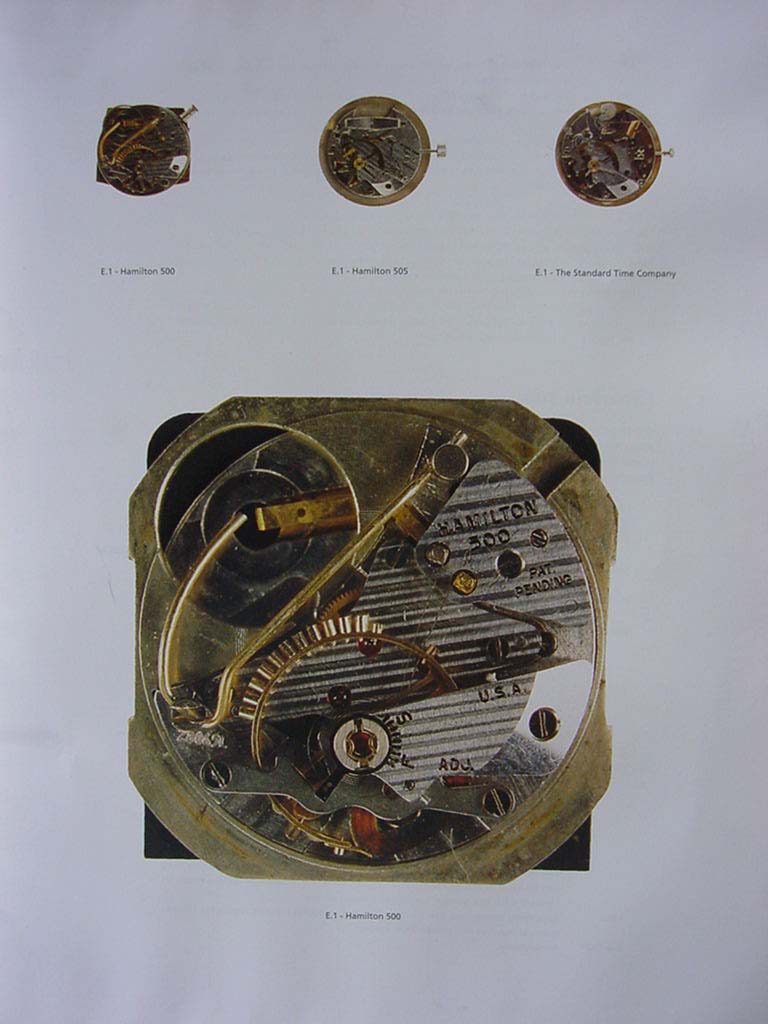
The Hamilton Watch Company of Lancaster, Pennsylvania USA won the race to introduce
the world's first electric wrist watch. It was also the first factory to start mass production of the electric wrist watch.
The connection between Hamilton and Epperlein is an interesting story, however, difficult
to unravel. Undoubtedly both factories have benefitted from each other's patents, since
the watches show great similarity. Certain patent rights owned by Hamilton indicate
Epperlein as the inventor of the electric wrist watch (See below in paragraph on Epperlein).
The complete history of this watch is accurately described in a book by René Rondeau
'The Watch of the Future, the story of the Hamilton Electric Watch'.
| 1946 | Hamilton's research manager, G. Luckey, starts exploring the possibility of producing a battery powered watch. | ||||
| 1946-1952 | Two prototypes of watches are constructed and examined:
| ||||
| 1952 | The Senior Physicist, Dr. John A. Van Horn, tests the watches and Hamilton decides to develop the permanent magnets model. Secret 'Project X' is started. | ||||
| 1956 | At the end of 1956 mass production commences. | ||||
| 1957 | On January 3rd, a press conference is held to introduce the 'Watch of the Future' in the United States: the world's first electric wrist watch. 'Project X' is completed after more than ten years of research. Two models are shown to the press, the 'Ventura' and the 'Van Horn'. Both are fitted with a 500 movement. The watch cases are manufactured by the Schwab and Wuischpard Watchcase Company. The basic models are designed by Richard Arbib. | ||||
| 1957 | The 'Ventura' and the 'Van Horn' go on sale in the USA in April 1957. The watches become a tremendous success. | ||||
| 1959 | Movement 500 A is released. | ||||
| 1961 | Model 505 is released in May. | ||||
| 1966-1968 | Some ladies' prototype electric watches are assembled, however Hamilton does not take them into production. | ||||
| 1969 | The production of the Hamilton Electrics ends. The total number of electric watches produced by Hamilton (caliber 500 and 505) equals approximately 42,000 pieces. | ||||
| 1970-1972 | One part of Hamilton and the brandname Hamilton are sold to SSIH (Omega), and another part is transformed into HMW Industries Inc.'s subsidiary, 'Time Computer Inc.'. This company manufactures the Pulsar and sells LED modules to SSIH-Omega by means of contract. Omega will sell these watches later under the name 'Time Computer'. |
The following different movements can be found:
| 500 | This is the first Hamilton electric movement. The movement caused many problems. During the first month after its release, about fifty percent were returned to the factory. The effect of a hasty introduction was enhanced by a lack of servicing facilities. The 500 movement was produced during three years. |
| 501 | Prototype very similar to the Epperlein 100. |
| 500 A | This movement is slightly different from the 500 and 501. The 500 has a wire spring to hold the battery in place, the 500A has a clamp to avoid damage to the very delicate contact wires. A new time regulator system was fitted. |
| 502 | This is in fact the 505 model. The reference number 502 was only used for a short period of time. |
| 505 | The 505 had a totally renewed contact system which did not need any adjustment. The main problem with the 500 seemed to be solved with this system. |
| 505 C | Prototype with calendar. |
| 507 | Calendar movement. In 1967, shortly after the production was started the company decided to terminate the project. Only about 25 movements were produced. |
In the nineteen sixties Hamilton lost its leading position and started production of the 'Vantage' series. This series contained 505 movements produced by Ricoh, Japan.
Well hidden inside original Hamilton cases, they were sold under the label of 'The Standard
Time Company'. Although the electric movements were derived from the 505, Hamilton did not want its name associated with these watches.
During the nineteen seventies, Hamilton imported the following Swiss transistorised
movements with balance: ESA 9150, 9154, 9157, 9158, 9200 and the quartz watch ESA 9181.
These watches were marketed under the name 'Hamilton Electronic'. The name 'Hamilton'
did not appear on the case or the movement.